
How Much to Transport a Car From Austin to Seattle? (2026 Cost Guide)
Based on my own research, shipping a vehicle over 1,600 miles from the hill country of Austin, Texas to the Pacific Northwest in Seattle, Washington isn’t just a matter of loading a trailer it requires navigating major freight corridors across multiple state lines.
Based on our years of managing cross-country logistics, we know that understanding how real world Austin to Seattle car shipping cost structures work can save you hundreds of dollars in broker markups. Knowing these details upfront ensures you can safely ship a car from Austin to Seattle without unexpected transit delays or hidden fees.
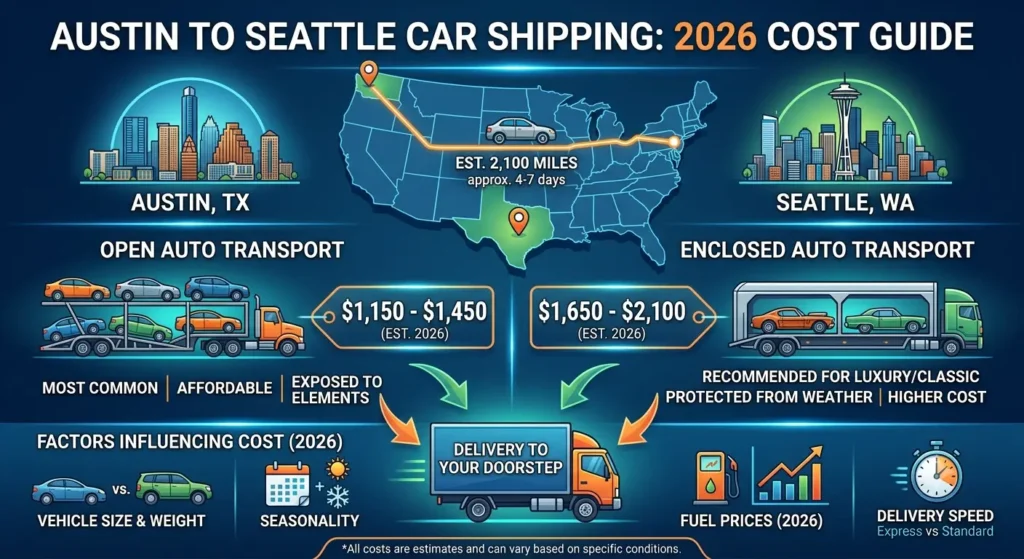
Austin to Seattle Auto Transport: Core Route Metrics
Before diving into quotes, our logistics team maps out the baseline logistics for this specific Pacific Northwest lane:
- Average Distance: ~1,650 Miles (primarily tracking via I-35 North to I-90 West)
- Estimated Cost Range: $1,199 – $1,665 (depending on trailer type and season)
- Transit Time: 3 to 5 Days in real-world transit conditions
Real World Cost Breakdown: Open vs. Enclosed Carriers
We don’t believe in automated low ball estimates that carriers will ultimately reject. Here is how our team benchmarks real market pricing structures for this specific route:
🚚 Open Carrier Fleet Transport (The Standard Choice)
For standard sedans, SUVs, and daily drivers, booking an open multi-car carrier keeps your cost per mile highly competitive. This method exposes the vehicle to standard road elements but remains the most cost-effective solution, typically ranging between $1,199 and $1,399.
🔒 Enclosed Auto Transport (The Premium Choice)
If you are moving a luxury vehicle, a classic car, or a low-clearance sports car out of Austin, we always recommend enclosed trailer routing. This seals your vehicle away from road debris and weather anomalies across mountain passes, commanding a 30% to 40% pricing premium (typically ranging from $1,550 to $1,850+).
5 Market Factors Impacting Your Texas to Washington Quote
When calculating a binding estimate, our dispatchers analyze several shifting variables that directly control carrier bidding behaviors:
- The Time of Year & “Snowbird” Waves: Booking during late autumn or early spring creates regional demand spikes. We track seasonal capacity issues to ensure your order gets locked with verified carriers before rates climb.
- Fuel Price Indexing: Fluctuating diesel expenses heavily influence driver margins. Our team reviews weekly Department of Transportation (DOT) fuel data to calculate realistic fuel surcharges.
- Vehicle Footprint (Size & Weight): Transporting a lifted truck or an oversized dually requires more deck space on a lowboy trailer than a compact sedan, directly impacting the final bill.
- Operability (Winch vs. Roll): If your vehicle is inoperable (cannot steer, brake, or roll), we must source specialized winch-equipped carriers or flatbed tow trucks, which adds a specialized rigging fee.
- Route Density & Zip Code Accessibility: Picking up right off the I-35 corridor in Austin and dropping off in a metro Seattle hub is significantly cheaper than requesting a carrier to divert into remote rural areas.
Driver’s Choice: Shipping vs. Driving Across State Lines
Many customers ask us if it’s cheaper to just drive the 1,600 miles themselves. When we run the hard numbers, the true costs of a DIY road trip quickly add up:
- The Hidden Toll on Your Car: A cross-country drive adds substantial mileage, accelerating depreciation and vehicle wear-and-tear.
- Road Hazards & Fatigue: Driving through unpredictable weather conditions and mountain elevations across Idaho or Montana causes severe driver fatigue.
- The Financial Equilibrium: Once you factor in multiple hotel stays, highway dining, fuel costs, and the value of your personal time, hiring a licensed broker to secure a direct carrier assignment often ends up being the more cost-effective and stress-free option.
Step by Step: How Our Car Shipping Process Works
We have streamlined our vehicle logistics into three transparent steps to eliminate common industry headaches:
Step 1: Secure Your Binding Estimate
You provide your vehicle dimensions, condition, and target dates. We calculate a realistic quote based on live carrier availability protecting you from the classic broker bait-and-switch pricing traps.
Step 2: Vehicle Inspection & Pickup
When our assigned carrier arrives at your Austin location, you and the driver will perform a comprehensive walkthrough, noting any pre-existing imperfections on the official Bill of Lading (BOL) before loading.
Step 3: Secure Delivery in Seattle
The carrier tracks along the interstate corridor directly to your destination. Upon arrival, you perform a final inspection, sign off on the BOL, and safely take possession of your vehicle.
Transport a Car From Austin to Seattle FAQs
Ready to book your Austin to Seattle Auto Transport?
Have questions before you book? Our transport specialists are available right now to guide you.